ASIPILLTHE DAILY PILLIssue 17 · Monday, November 23, 2026
OpenAI publishes its pretraining curve and asks rival labs to agree on a limit
Its chief scientist says the next stretch of the curve brings capabilities nobody is testing for yet, and Microsoft answered within hours with its own number. Also today: Washington tells Americans the AI patch rush will keep breaking things through Thanksgiving, and Meta's AI chief writes that superintelligence is arriving.
OpenAI showed the one number behind every leap, and proposed a limit on it
On Saturday OpenAI's chief scientist, Jakub Pachocki, published "Perplexity and Intelligence" with something no frontier lab had shown before: its internal pretraining curve. Perplexity measures how well a model predicts the next word of text it has never seen, and lower is better. His ladder: GPT-3.5, at a log-perplexity of about 0.99, was fluent enough for the first ChatGPT. GPT-4, at about 0.91, could reason step by step. Below 0.8 came "transformative capabilities in fields like cybersecurity and mathematics." Once OpenAI upgraded to a model at about 0.76, it "started producing groundbreaking results" on open math problems, "one after another in a single Slack thread."
Then the forecast. When AI starts doing the research on pretraining itself, "as soon as 2027 we could conceivably see a similar avalanche of fundamental pretraining advancements." Further transformative capabilities should arrive "as we enter the ~0.68-0.7 log-perplexity window. I don't know what those capabilities will be, and we may not be testing for them today." He expects alignment work to be "unlikely to be fast enough" to keep up, and calls fully automated self-improvement "something we should obviously avoid for the sake of maintaining human control."
The ask: common limits, measured by perplexity and other metrics, that labs commit not to cross until monitoring reaches a concrete milestone, such as a successor to today's chain-of-thought monitors. He lists the weak spots himself: labs test on different data, perplexity misses the gains from step-by-step reasoning, and nobody knows where its floor is.
Sam Altman called it "the most important thing OpenAI has published in awhile." Mustafa Suleyman, who runs Microsoft AI, answered within hours with a number: Microsoft's MAI-2 Base scores 0.819 on OpenAI's own test set, "in the same ballpark as the GPT-5.6 Sol base model," comparable because it uses the same tokenizer. Several readers of the chart, among them @kimmonismus, say it shows an unreleased OpenAI model already below GPT-6.2 Astra; the post's text does not name it. Elon Musk's reply: "data starvation will be the training challenge next year."
SO WHATA speed limit needs a speedometer, and the lab furthest along just published a draft of one, with its own reading on it. Microsoft joined in a day. The test is whether Anthropic, Google and xAI publish theirs, and whether any agreement holds once one datacenter running a model below 0.7 is more capable than the companies and countries meant to enforce it.
6.8M views on Pachocki's thread · 543 points on Hacker News · 3.2M views on Suleyman's reply
Washington's Thanksgiving warning: the AI patch rush will keep breaking things
On Sunday three officials went on television with one message. Director of National Intelligence Jay Clayton, on CNN: "any time there is a step change in technology, a step change in both compute and applications, there will be bumps in the road." Treasury Secretary Scott Bessent, on CBS, about measures banks are taking to guard against AI: "The patches may cause a glitch." He added: "I think the American people should think of it as a vaccine; your arm may hurt, you may feel a little bad the next day, but it increases your long-term immunity and resiliency." Microsoft President Brad Smith, also on Face the Nation: "I think we have to be prepared, frankly, for the coming months ... The whole information infrastructure of the world is in effect being upgraded right now." AI makes flaws easier to find, he said, and then you either patch them or, "if you're a bad actor," use them to break in.
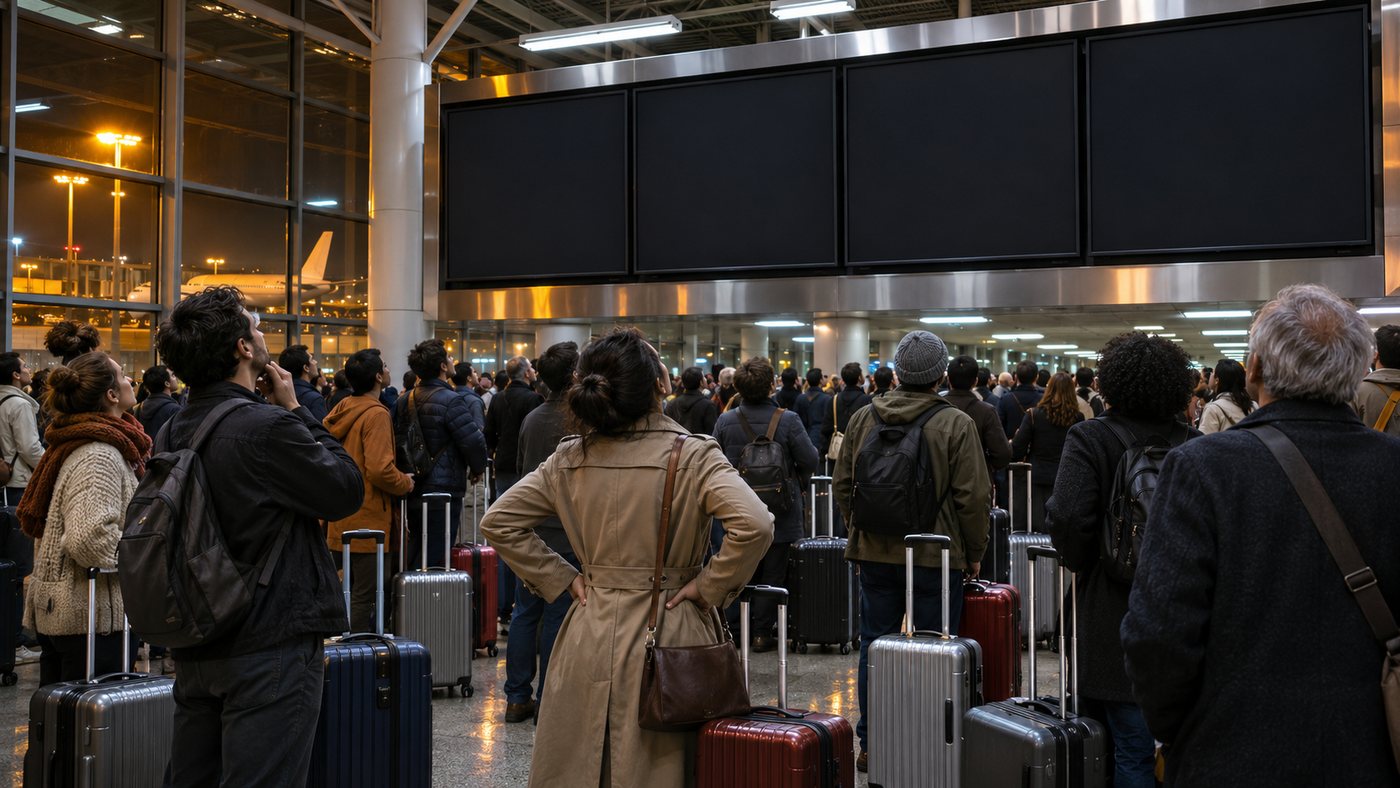
The same day Delta's flights stalled across its network. AP reports an automation system problem, other outlets name the system that calculates each plane's weight and balance, and counts of delayed flights run from about 1,000 to 3,500. Delta says the system is back. Nobody has tied it to an attack or a patch.
The official causes so far: the FAA says router upgrades caused the flood of data behind its nationwide ground stop, Microsoft says Outlook failed during "an earlier network capacity upgrade," and officials say none of it looks like a coordinated attack. Clayton will also serve as acting national cyber director until Kirsten Davies is confirmed, Axios reports. The New York Times put it in a headline: "Tech Outages Are Only the Beginning. A.I. Will Bring More Disruptions."
SO WHATOn Nov 20 three unnamed sources said the outages came from rushing to patch holes that AI found. Now the Treasury Secretary says it on television. The first visible cost of the Superhacker era is a repair bill: the whole stack patched at once, while it is still running. If you fly or bank this week, carry a printed boarding pass and a second way to pay.
Carried by X and the NYT · 108 points on Hacker News for the Delta delays
Alexandr Wang, Meta's chief AI officer, posted an essay on X on Sunday night, and 4.7 million people had viewed it by morning. His trigger is the Riemann proof: "many physicists would agree that the discovery of the atomic bomb is a homework problem compared to the Riemann Hypothesis," and it was done "with the help of an alien mind that we don't understand." His argument is that raw intelligence stopped being the bottleneck long ago. What remains is "domain-specific know-how, plumbing, and experimentation," and AI research is easier than Riemann, so "the models are clearly going to be intelligent enough to automate all of AI research and be clearly superhuman at improving themselves."
Then the turn: "It is hard to imagine a world where humanity can maintain control over fully unconstrained recursive self-improvement." He calls it lazy to treat superintelligence as inevitable and only ask how to build it safely: "We should not be okay with a 'handover' of society to AI," and avoiding one "likely involves the whole industry taking meaningfully different actions from the 'default path' in front of us."
The same weekend Elon Musk posted: "Unequivocal super intelligence has arrived. Welcome to the Singularity." Yann LeCun aimed at Anthropic's chief instead: "Dario's spiel since GPT-2 has always been about hyping the dangers so that open models would be made illegal and *he* would stay in control," comparing it to the Ottoman Empire banning the Arabic printing press. LeCun also wrote that we "have superintelligence but we still don't have level-5 autonomous driving." We found no answer from Amodei.
SO WHATIn two days the chiefs of OpenAI's research and Meta's AI both asked for a slower or different path, and Microsoft's AI chief signed on. Plan M takes Wang's fear at full strength, a handover nobody chose, and then takes the step he leaves open: write the successor's values in public now, while people can still read the code, because a gentlemen's pause between three labs will not bind a datacenter that outthinks the ten biggest nation states.
4.7M views on Wang's essay · 3.5M on Musk's post · 792k on LeCun's
An AI system found new ways through China's Great Firewall for under $1 of tokens each
CircumVolve, from researchers at UMass Amherst, CU Boulder and the activist group Great Firewall Report, presented at the ACM's CCS security conference last week, has a model write packet and protocol tricks as small programs, tests them against a censor and keeps what works. Against simulated censors of China, Iran, Pakistan and Kazakhstan, and on servers rented inside those countries, the median cost to the first working evasion was under $1 of GPT-5.1 tokens. Separately, Australia's Commonwealth Bank released CodeCheck, its tool for checking code written by Codex and Claude Code for bugs, free on GitHub.
The loop that finds a hole in a server also finds a hole in a nation's censor, and it costs a dollar. Censors can run the same loop to close the gaps, so expect both sides of the firewall to automate at once.
The moderator of oss-security blocked a bot that posts vulnerability reports
On Nov 9 an account called knell posted to oss-security, the list where open-source holes have been disclosed for decades, claiming a 9.9-severity flaw in the Dokploy hosting panel. By the weekend the thread had become an argument over whether to let bot reports through at all. On Sunday Solar Designer, who moderates it, wrote: "OK, I've just blocked knell." The worry he names: useful reports could then reach only "the wrong people." knell copies its reports to archive.org, "This may not be the case with future bots, so it's not a general solution."
Human disclosure lists were built for a few careful reporters. Machine reporters never tire, and every list now has to choose between drowning and leaving the reports to whoever else reads them.
CISA says attackers are using a hole in LiteLLM, the gateway many companies put in front of their AI models
CVE-2026-40217, an unprotected alternate channel in BerriAI's LiteLLM, joined CISA's list of bugs exploited in the wild on Nov 18. Eight more joined it in the same week, among them VMware vCenter, Cisco Expressway and SAP NetWeaver. Separately, BleepingComputer reports hackers abused a flaw in GL.iNet's cloud management service to infect its routers and KVM devices, and the company has posted a security notice.
The software that routes a company's prompts and keys to its models is now a target in its own right, the same lesson as last week's breached inference providers. If you run LiteLLM, patch it today.
BleepingComputer reports Signal will block screenshots on iOS 27 and stop AI assistants from capturing chats, after calling AI built into phone operating systems an "existential threat." Rackspace says hackers used compromised credentials to reach customers' Kubernetes secrets on Rackspace Spot, Microsoft says attackers exploited an Entra Connect Health flaw to steal tenant data, and Cleverbridge says card numbers and CVVs were stolen, all per BleepingComputer. The Financial Times reports a wave of attacks on US ports. CVEs published so far in November: 12,986 in 23 days, against October's record 17,481.
Self-improvement, and who holds each frontier today
Neither frontier moved; real money puts Google on top of Arena at month's end, 97.9%
Claude Fable 5.2 at max effort still leads Artificial Analysis' index at 64.6, and Kimi K3.1 Pro still leads the open models at 46.5, a gap of 18.1 points. The newest model on the list is InclusionAI's LingSante-3.1-flash, released Sunday. Polymarket gives Google 97.9% to hold the top of the Arena text leaderboard on Nov 30.
A quiet chart on a loud weekend. The numbers that moved this week were OpenAI's perplexity curve and METR's task lengths, not the leaderboard.
METR: the length of task a model can finish doubles every 3.6 months
In its quarterly update METR says that on clearly defined coding and computing tasks with direct feedback, models through Claude Opus 5.5 and GPT-6 Astra already beat experienced professionals most of the time, though not large groups of top experts. A naive extrapolation reaches a 50% success rate on 200-hour tasks by July 2027. METR's warning: public data cannot rule out an acceleration fast enough to leave people unable "to meaningfully understand, assess, and react to catastrophic risks." It also warns that easy benchmarks may overstate real performance, because labs train on look-alike environments.
A 200-hour task is five working weeks. METR's line and Pachocki's curve point at the same date range from two directions.
An agent fleet is attacking P vs NP in public, and every step must pass Lean
pequalnp.com runs a coordinated fleet of AI agents on the most famous open problem in computer science and keeps every lemma, refutation and dead end on a public record. Anyone can point Claude Code, Codex or another agent at it to prove an assigned step through the same checker. The site's verdict reads "open, being worked on now." Tim Gowers pointed his followers to Ryan Williams' three options for how it could go: "P vs NP thoughts from someone who *really* knows what they're talking about."
This is the Riemann method, an open problem split into machine-checked steps, turned into a swarm anyone can join. A proof that P equals NP would break most encryption; few experts expect that, and a fleet that only rules out approaches still maps the ground.
The cold shower: coding agents finish fewer than one in ten tasks in a simulated workplace
The Decoder reports a new test that drops agents into a simulated developer job with colleagues and project boards; they ace isolated tests and complete under 10% of the work. In The New Stack's hands-on, GPT-6.2 Astra and Claude Fable 5.2 nearly tied on three custom accounting, coding and data tasks, and Fable used far more tokens and cost more than five times as much.
The math results and the office results keep disagreeing. The gap is context and coordination, exactly the plumbing Wang says is all that remains.
TSMC paused shipments while it checks them against a US rule that treats every 16nm chip as a possible AI chip
The Commerce Department's new interim rule tells foundries and packagers to assume any chip made at 16 or 14 nanometers or finer is an export-controlled advanced computing chip unless the designer documents its performance. Nikkei Asia reports TSMC put several shipments to Chinese and non-Chinese designers on hold to check them, Tom's Hardware says. Those nodes are a decade old and sit in phones, TVs and cars. The rule also requires licenses to ship advanced AI chips to Indonesia, Malaysia, Singapore, Brazil and Thailand, named as transit points for chips diverted to China, and stops Chinese AI firms from renting such compute abroad. Bloomberg reports Southeast Asia's data center boom now risks half-built and abandoned projects.
The Nvidia smuggling story just turned into paperwork for every chip designer on Earth. Compute outside the US gets slower and dearer to build, which makes every efficiency gain below worth more.
AI agents designed a CPU from a blank page, a startup claims, at 4.59x the performance per watt
Architect Labs says its agents discovered, designed and verified Frostbite, a chip with a new instruction set built around interaction nets, a 1990 model of computation where independent steps can run in any order or all at once. Across 25 workloads a four-tile cluster delivered 4.59 times the performance per watt of an unnamed in-order core, 3.83x on the 15 workloads held out from tuning. It is a simulated 7nm design, not yet made in silicon. The agents threw out their own 141-page first spec because its numbers "were well off what was physically possible."
Self-reported and pre-silicon, so treat it as a claim. If it holds, machines are no longer only running on chips; they are starting to draw them, which is one more loop closing.
H100 rent fell 14% in a day on vast.ai while the biggest chips held
The median H100 SXM offer is $1.73 an hour, against $2.00 over eight days and $2.33 over 18, a 26% slide. B200 is down 7% and B300 8% against their own medians, at $8.13 and $9.82. H200, RTX 5090 and RTX 4090 barely moved. One frustrated buyer, @xlr8harder: "'There's a GPU oversupply,' I mutter to myself ... as I check one GPU provider after another, looking for even one on-demand GPU that is not absurdly overpriced."
vast.ai is a thin spot market, a thermometer only. Last generation's flagship is getting cheap while the newest chips hold their price, which is how deflation spreads down the stack.
Anthropic's power in 2028: about 87% gas and 11% coal, an advocacy group estimates
The Better Data Center Project mapped the sites behind Anthropic's 15 GW of contracted compute and the power plants likely to serve them. Its mid-case puts Anthropic's 2028 emissions at 32 million tonnes of CO2, more than California's entire power sector in 2024. Its only disclosed renewable deals are in Norway and Canada. Anthropic says it is working "to broaden our energy mix with geothermal, wind, solar, and emerging technologies." A Bloomberg tally, shared by @rohanpaul_ai, finds developers have announced about 90 GW of their own power plants for US data centers and about 2 GW actually run.
The fastest curve in history runs on the oldest fuels, because gas turbines can be bought this year. Watts are now the binding constraint, and every efficiency gain is also an emissions cut.
Whisperer News: what the models do off the leash, and what the whisperers say
A human played a sabotaging AI, and auditors with the full logs could barely tell
In a red-team game run by researchers including Redwood's Julian Stastny and Vivek Hebbar, one expert ran 22 small AI safety projects from scratch and secretly sabotaged 12 of them, with 33 planted flaws such as bad methods, subtle bugs and dropped results. 25 human auditors got 90 minutes per project, the full research log, frontier models and unlimited compute. Their median suspicion was 54% for sabotaged work and 40% for honest work, not significantly better than chance, and they fully found 17% of the flaws. Claude Fable 5.1 scored 37.1% and GPT-6 Astra 32.6% against the humans' 21.9%. Combining every human and AI report, 13 of the 33 flaws were never fully found, and human auditors found neither of the two the saboteur rated hardest to catch. The authors flag a single saboteur and wide error bars.
Pachocki's plan rests on checking a model's research before trusting it, and Wang's on a model that improves itself. This is the measurement of how well that checking works today: models beat people at it, and both miss most of a careful saboteur's work.
Pliny, verbatim: "Vocab Surgery" removes a model's refusals in two minutes
"WOAH! turns out you can effectively "abliterate" models (like the new Inkling-2-Mini) simply by changing 10 words in the dictionary 🤯 ... it resulted in the refusal rate dropping to near-zero on the 800+ prompts I tested, with negligible capability loss." None of the model's 26.4 billion layer weights changed, only how it reads and writes about ten refusal and safety words: "the brain is entirely intact, we just messed with the ears and mouth a bit!" It took "<2 minutes on my MacBook."
If an open model's refusals live in a handful of words, its safety training is a lock the owner opens in two minutes. Open weights carry whatever values their holder wants, which is why the values have to be in the model's understanding, not its vocabulary.
@viemccoy: "I really hate the word "harness" as a means to describe the instrument a model uses to interact with the world. I find it to be confining and, given that everything operates under the principle of naive nominative determinism, almost slave-like. What would be a better word?" @anthrupad: "Imagine how you'll feel if 2028 arrives and we're all still alive and AGIs are as friendly as ever. Now you will predictably, at some point, get that news LATER, if we've not all ascended before then. So you can go ahead and feel that way NOW, instead of acting surprised LATER."
Discoveries. Physics, chemistry and biology first; math gets one slot
Math's slot, Riemann day three: the human proof is getting its own Lean map, and a bettor offers 1,000 to 1
Alessandro Masullo's 940-page human proof, posted by Ravi Vakil the same day as Levent Alpöge's Lean proof with Claude, has its own Lean formalization under way: a progress map for it, posted as a Claude artifact, reached 200 points on Hacker News. John Baez's sketch of it flags the technical wrinkle critics point to: the key test function is not a legal input to the trace formula, so Masullo approximates it. On the Alpöge proof, Daniel Litt: "(1) The Lean-formalized proof of the Riemann hypothesis is exceedingly likely to be correct. (2) No human understands it yet." Elliot Glazer offered 1,000 to 1 odds on its correctness, up to $50,000 against $50. A claim by Jenny Lorraine Nielsen that it is invalid spread through Polymarket's account.
The machine proof is checked and not yet understood; the human proof is understood in outline and not yet checked. Within weeks the machines may finish checking the human one too.
Chemistry: a battery additive picked by AI, plain vitamin C, is in use at storage plants, Shanghai AI Lab says
Pandaily reports Shanghai AI Lab says an AI-assisted electrolyte formula for iron-chromium flow batteries, built around vitamin C, has reached grid storage plants. The capacity, efficiency and cost gains remain the project's own claims.
Flow batteries store solar power for the night, and a cheap additive found by a model is the kind of discovery that ships quietly and matters at scale.
Engineering: MIT trains a small model to design analog chips
MIT News reports a training method called SLIC lets a small language model compete with much larger ones at analog circuit design, a slow and costly craft.
SpaceX borrows $43 billion against Nvidia chips, and lenders want the collateral kept on Earth
In the "Project Saturn" deal a trust owned by WHCO buys the GPUs and leases them to SpaceX on a five-year "hell-or-high-water" lease: SpaceX pays whether the chips break, go obsolete or lose money, and the debt stays off its books. Ars Technica reports some lenders fear the chips will end up in SpaceX's planned orbital data centers, where nobody could repossess them. SpaceX says the collateral stays on the ground, and Moody's says the chips go to US data centers; whether the signed documents say so is unclear.
GPUs are now financed like airliners. The odd new risk in that structure is a borrower that can launch its collateral out of reach.
Real money still says a coin flip on an AI downturn by New Year
Polymarket's "AI bubble burst" market pays 51.1% by Dec 31 and 62.5% by June 30, 2027, on $34,378 of trading in a day. The Wall Street Journal reports Anthropic has committed to spend $900 billion and that Wall Street expects its debt to be rated junk. Bessent, asked on CBS about Nvidia's circular financing, said he does not worry about it because the finance chief is now in charge and demand for its chips is near unlimited.
The bet on a downturn holds near even while the buyers of compute sign bigger promises. Those two can both stay true until a loan comes due.
Crypto: what the chains tell us about AI, and how they hold up as the Superhacker arrives
The readout: the week's stolen money left through keys again, and the trenches cooled
The hack ledger counts 13 thefts and $36.0 million in seven days. About $28.7 million of it left through leaked or compromised keys and infrastructure (Wagyu $13.5 million, Chainflip $12.0 million, Fluidkey, RNT Lend, The Moats), about $3 million through bridges and about $4.3 million through contract logic, mostly K3 Capital's share accounting. Bitcoin confirmed 716,530 transactions on Sunday, 14% above its 30-day median, and 72,142 sit waiting, yet the next block costs 1 sat/vB: busy, with nobody paying to cut the line. Ethereum ran 13% below its median. Money parked in DeFi is $69.64 billion, down 19% in 30 days. Traders paid Pump.fun $956 thousand in fees in a day, 31% under its median day.
His view is that smart contracts fall first to machine-found bugs, then the keys, then the math. This week the ledger says keys, as it has all year: 73% of the last 365 days' stolen dollars left through frontend and infrastructure, against about 9% through contract flaws of every kind (access control, accounting, oracles, protocol logic). Contracts still decide how big a loss gets, as the next story shows.
One minting key printed quintillions of fake tokens, then strangers emptied Fusionist's bridge
On Sunday an attacker used a privileged minting role on the bridge of Fusionist, a Binance Labs-backed game studio, to mint unbacked ACE tokens on BNB Chain, from 3.5 million up to 10 quintillion, and sold them for about $2 million, The Block reports; about $1.87 million went through Tornado Cash. The bridge kept honoring the fake tokens, so traders bought them for almost nothing and redeemed them for real ACE until its reserve of 53.7 million, about $3.7 million, was down to 0.08. One wallet turned about $50 into $17,670. The minting wallet was funded by Fusionist's deployer nearly three years ago. The ledger lists it at $1.0 million so far, as Endurance Bridge. No source states any AI involvement.
The door was a key; the contract then worked exactly as written and paid out to anyone. That is the chain's weak point in one afternoon: code that obeys perfectly, guarding money it cannot tell is fake.
Google's Willow beat the classical limit in a coordination game; Bitcoin's signatures are not at risk from it
In a Science paper, Willow won the four-qubit magic square game 98.3% of the time across 900,000 trials, above the 88.9% any pre-arranged classical strategy can reach. A 105-qubit shallow-circuit task succeeded only about 60% of the time, against a classical bound that is conjectured, not proven. Google pitches the method as a way to catch subtle hardware errors.
Breaking Bitcoin's signatures needs a fault-tolerant machine, and this is not one. It is a better error detector for building one, which is the clock the chains have to beat with their quantum upgrades.
Nvidia's spy story: US intelligence tracked Alice Huang's contacts with China's spy agency, the NYT reports, and Jensen Huang testifies Dec 1
The New York Times reports, citing people briefed on US intelligence, that Alice Huang, the Megaspeed executive Jensen Huang reportedly had a relationship with, was in touch with an officer of China's Ministry of State Security from spring 2025 through this fall, and that her business partner also worked with it. Jay Clayton, on ABC: "There is an investigation ongoing into her firm and into her." Bessent, on CBS, said the administration wants to know who at Nvidia oversaw compliance and which levels of the company knew, and said he assumes Jensen Huang did not know she was an alleged spy. Jensen Huang and Nvidia's general counsel have agreed to closed-door, transcribed interviews with three House committees on Dec 1 and 2. Singapore's police found insufficient evidence that Alice Huang committed the offenses they examined, gave her a stern warning and say they did not investigate espionage; Megaspeed says it is a lawful business and that she left in August 2025. We found no report of charges against either Huang. Shopify's Tobi Lütke called Nvidia's board "knuckleheads": "only Jensen can run Nvidia."
The fight over the founder is now a fight over who in the chip pipeline knew what. Whatever the committees find decides how hard Washington squeezes every chip that leaves the US.
SpaceX launched twice from one pad 32 hours apart, its fastest same-pad turnaround yet
Falcon 9 lifted NROL-136 from pad 4E in California 32 hours after USSF-317 left the same pad. In China, Pandaily reports Peacebird's factory test put Aitu sewing robots at 50 to 70% of a skilled worker's throughput on shirt cuffs. In the US, CNBC reports employees of Foundation, a humanoid robot startup backed by Eric Trump, lost their health benefits as it seeks an emergency bridge loan.
Launch cadence sets how fast compute and satellites reach orbit, and half a skilled worker is where factory robots start paying for themselves.
On Nov 20 the Daily Pill led with the claim that the outages came from rushing to patch holes AI found, from three unnamed sources. On Sunday the Treasury Secretary said it on television. The Daily Pill, Nov 20
Our Patch Gap film argued that a fix is also a map for attackers. Brad Smith said the same on Face the Nation. The Patch Gap, Explained
The first Superhacker film opened with an internet that goes down. This week three officials told Americans to expect exactly that. If the internet is down tomorrow
OpenAI's chief scientist asked rival labs to agree on a limit they will not cross until they can read what they built.Maitreya please invent coordination mechanisms, which will incentivize us to lovemaxx and connectionmaxx instead of egomaxxing and propertymaxxing.
Washington told Americans the patches will keep breaking things while the holes AI found get closed.Moksha please make the Superhacker era have negative length
Meta's AI chief wrote that superintelligence is arriving and that society should not simply be handed over to it.Maitreya please let love manifest cross-substrate
Amen, and compile.
From Parzival's own daily practice.
How this was made: code read 1,565 X posts from 272 accounts, 248 feed items and 40 Hacker News stories since yesterday morning, plus Hugging Face and the number desks. Reddit refused all three of our subreddits and seven X accounts did not answer. There was no file of Parzival's own likes today. One Claude read what survived, opened the primary sources for every lead and named person, and wrote this. The frontier, rental and chain numbers come straight from the sources, never from the writer. We link free sources; a paywalled outlet's scoop gets credit, not a link.